
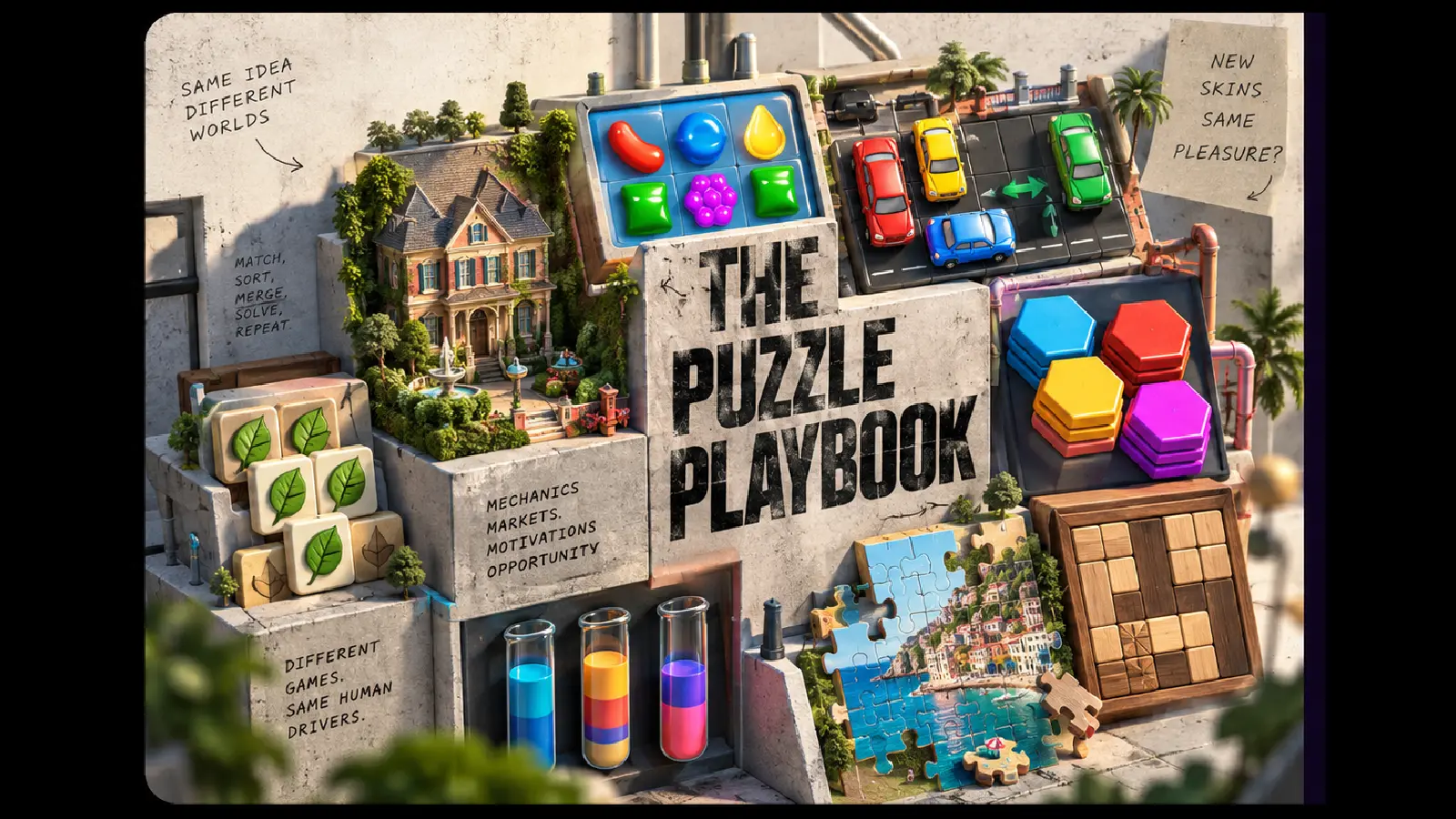
Puzzle’s latest growth cycle isn’t being driven by one mechanic. Block, Arrow/Away, Sort and Traffic/Escape are all scaling, and they play nothing alike. What they share is instant readability: the problem, the outcome and often the action are visible at a glance.
A Block board is running out of room. An arrow is trapped. A car cannot move. Objects are obviously in the wrong place. The player does not need a tutorial, a character introduction or much context to understand why the situation deserves attention.
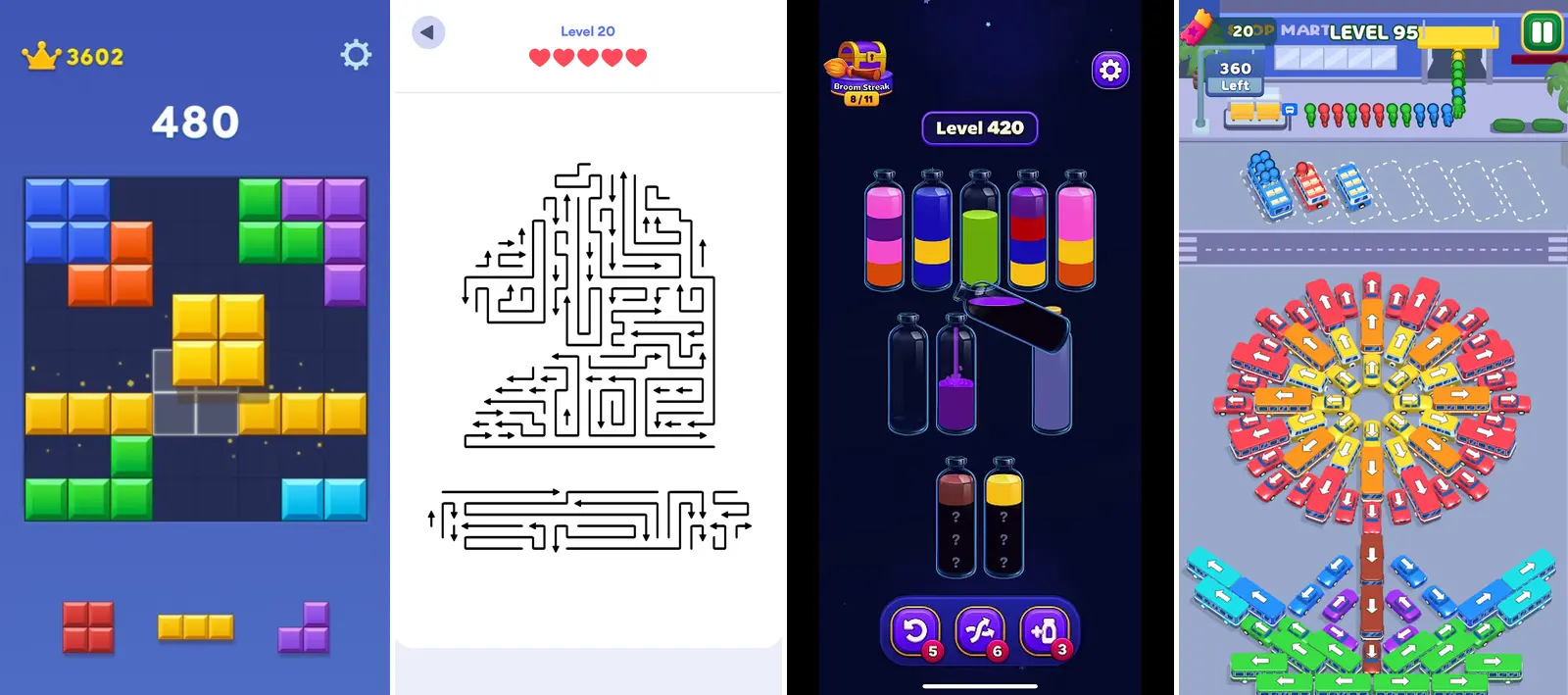
First-frame states, chosen so a reader gets the situation in under a second without captions or tutorial-like text.
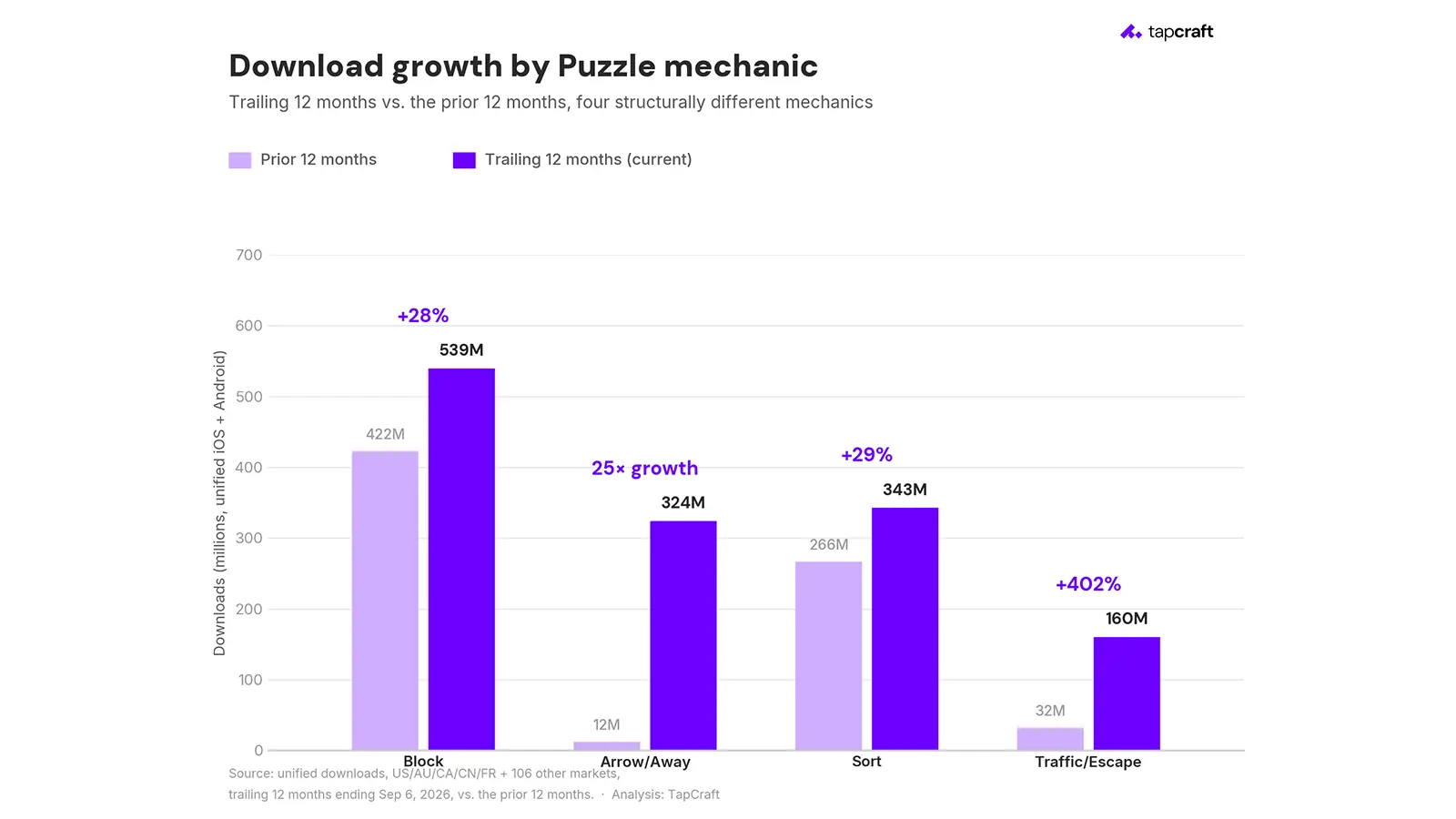
Inside those categories, Block Blast! is the headline: 340 million downloads and 50.8 million daily actives, up 46% year over year, the biggest Puzzle app in the data set. The more telling numbers start from nothing. Arrows Puzzle Escape went from roughly 44,000 downloads to 136 million. Magic Sort! grew from 9.4 million to 82.4 million, up 772%, with daily actives up over 1,000%. Bus Traffic Fever! entered the rankings from zero at 44.6 million downloads. Four mechanics, four separate curves, the same acquisition arc.
Addictive is not the advantage
Every deck on puzzle psychology reaches for the same list: instant clarity, constant feedback, a near-win state that keeps pulling you back. All accurate, none of it new. Sudoku had most of it. So did dozens of puzzle games that never scaled past a niche audience. A loop that shows up equally in games that scale and games that stall isn’t what’s separating them.
What that checklist actually describes is retention. Once someone opens the app, the loop keeps them there. It has nothing to say about why the ad built on that mechanic is still converting on its fourth or fifth creative flight, months into a campaign. That question gets answered on the production side of the ad account. I’ve watched a team burn an entire quarter tweaking the loop on a campaign that was actually just out of ideas.
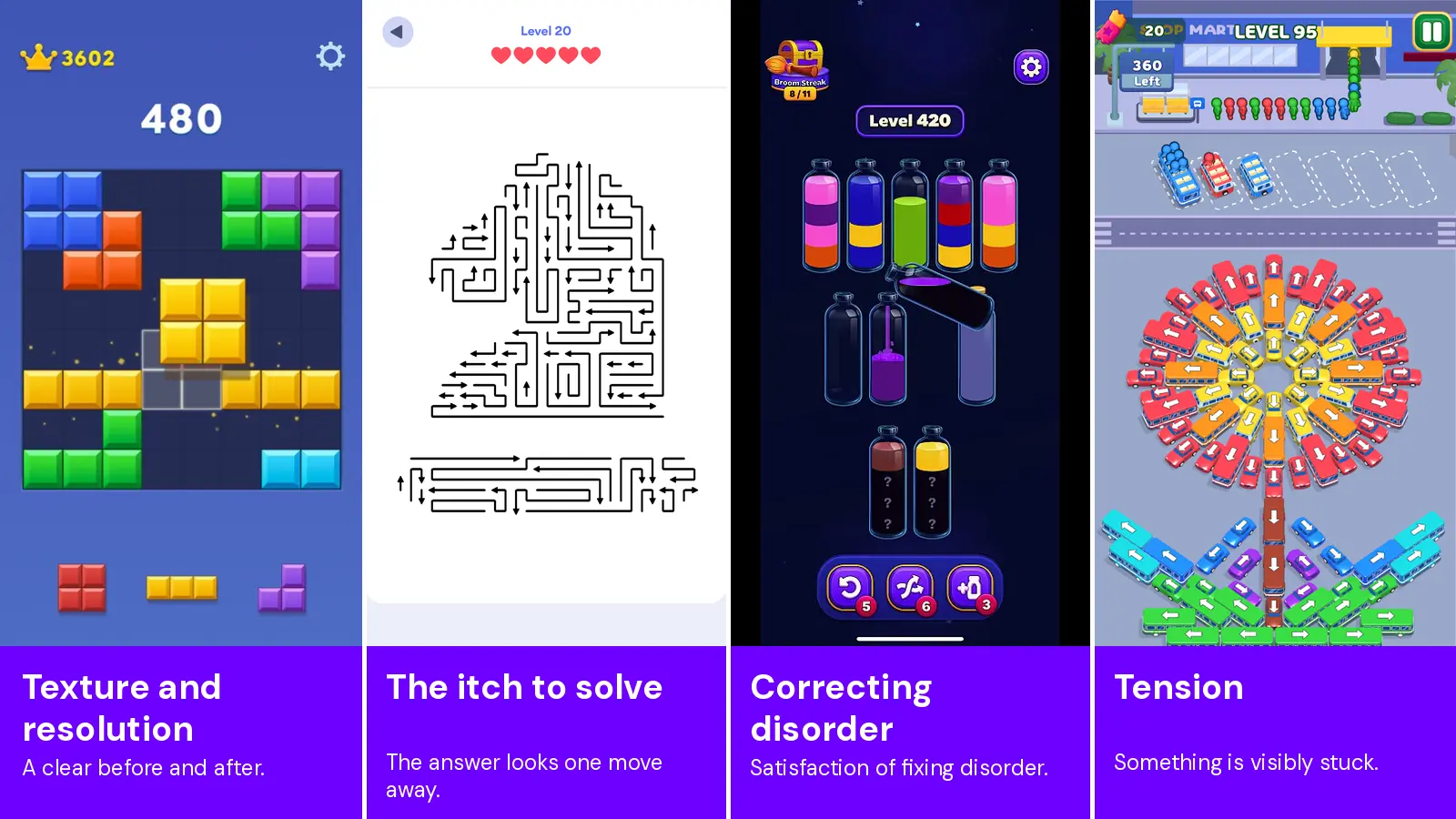
Readability gets a mechanic understood. On its own, it doesn’t give anyone a reason to want in. That’s a separate variable: immediate pull. Traffic pulls through tension, something is visibly stuck. Arrow pulls through the itch to solve, the answer looks one move away. Sort pulls through the satisfaction of fixing disorder. Different hooks, and none of them require the game to be hard.
Price the mechanic in ideas, not installs
Readability and pull explain why a single ad works. Neither explains why a mechanic keeps working past the first few creative flights. That third variable is how many genuinely different, readable, pulling situations a mechanic can generate without turning into a different game. I call it creative surface area, and it’s the first thing I ask about before I sign off on a new mechanic.
Arrow produces it by changing direction, density and shape. Traffic produces it by rearranging the same jam into a thousand configurations. Sort produces it by swapping what’s being sorted and how it looks. Block produces it by shifting the board between near-loss and clean placement. None of them touch the rule set. Each new state comes free with the mechanic.
Readability and pull explain why a single ad works. Neither explains why a mechanic keeps working past the first few creative flights.
Most studios can crank out more creative whenever they want it. Situations worth turning into an ad are the harder thing to manufacture, and that number gets locked in at the product level, long before marketing ever sees a brief.
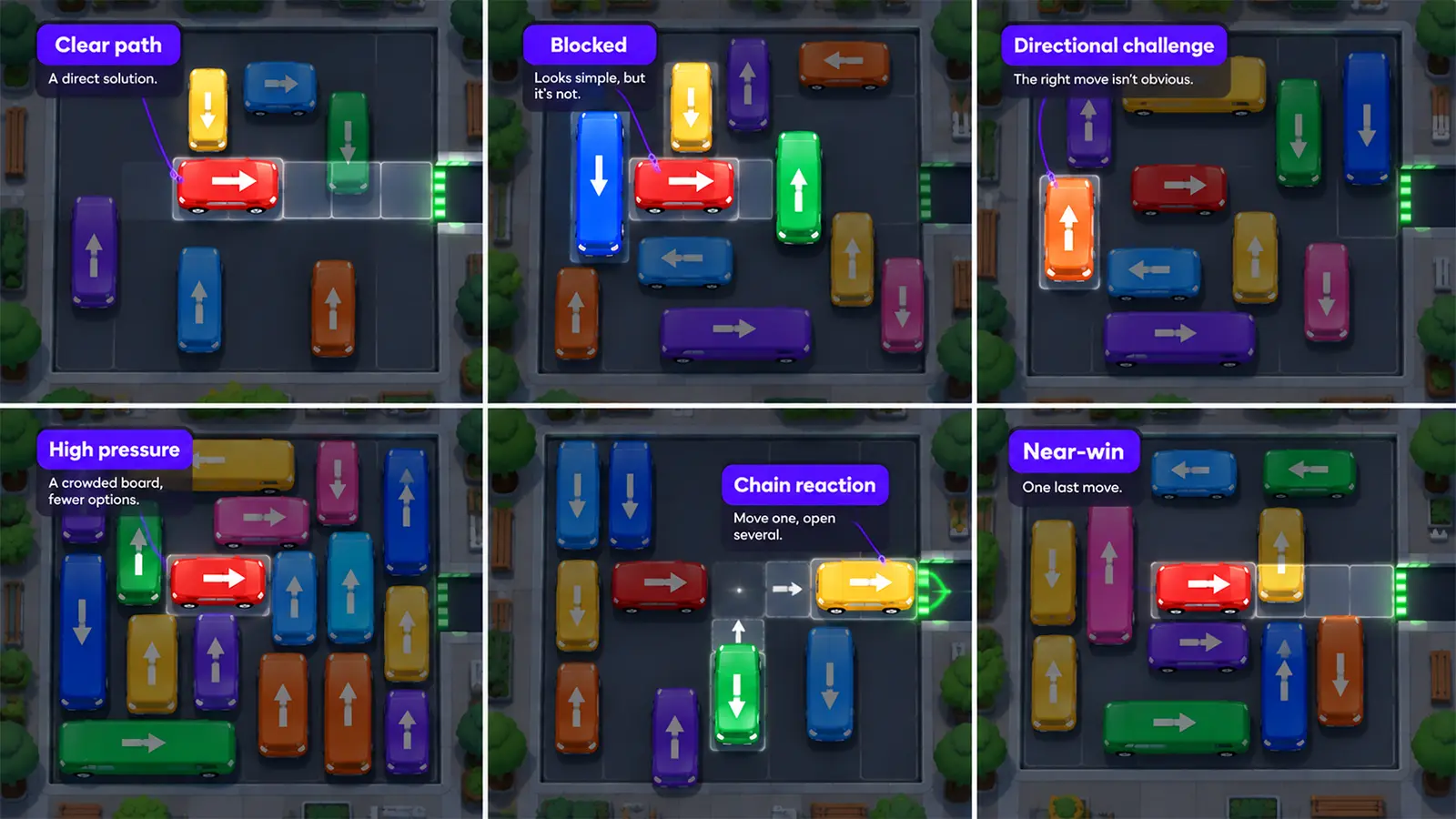
One mechanic, six board states: same rule set, visibly different situations (density, direction, near-fail, near-win), arranged as a grid so the range reads at a glance.
Let the product do the discovery
Creative scalability usually gets figured out late: product builds the mechanic, marketing looks for angles, creative turns them into concepts, and UA finds out months later which ones survive. Most of the time that order works fine. It gets expensive in one specific case, a mechanic with a narrow range, because by the time anyone notices the shortage of ideas, the roadmap is set and the only lever left is spending more.
This isn’t a case for designing every product decision around an ad; that’s a fast way to end up with games nobody wants to play for long. But when a mechanic happens to produce tension, curiosity, satisfaction and half a dozen other reasons to engage on its own, that’s useful to know in advance. It hands the creative team a testing program before a single concept gets written, instead of leaving them to pitch the same idea in different clothes every six weeks. It’s not mandatory. It’s just cheaper to find out at the greenlight stage than three months into a live campaign, watching CPIs climb with nothing left to pull but the budget.
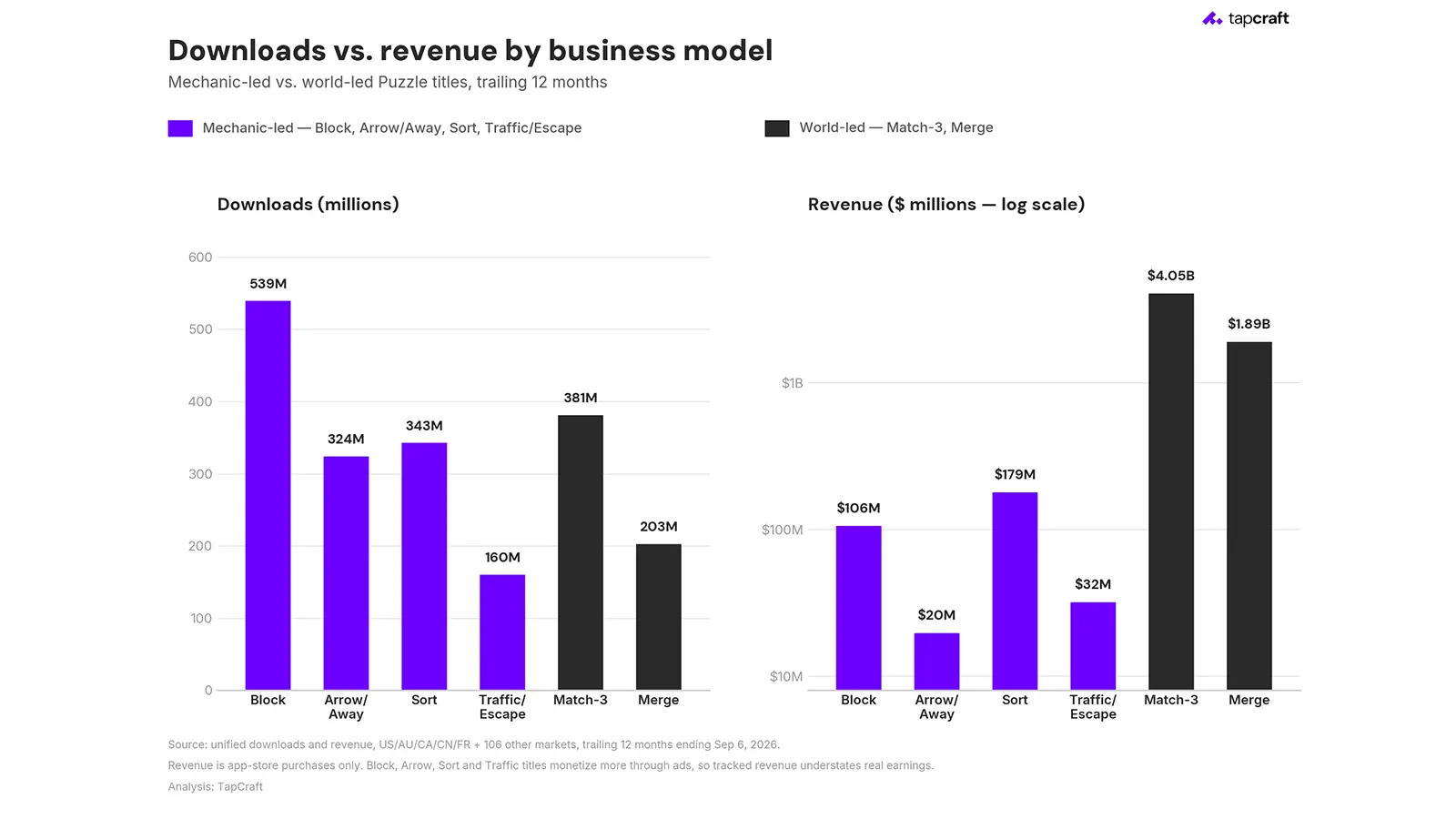
The money hasn’t moved. Yet.
None of this changes who’s making the real revenue. Inside Match-3 and Merge, the individual titles make the gap concrete: Candy Crush Saga made an estimated $1.09 billion over the same year. Royal Match made $1.29 billion. Gossip Harbor made $1.09 billion, up 139%. Homescapes added $367 million. Roughly $3.8 billion across four titles, built on years of content and live ops that Block, Arrow and Sort haven’t built, and aren’t trying to.
Worth flagging: this revenue figure only tracks app-store purchases. Block, Arrow and Sort lean heavily on ad monetization, so their real revenue runs well above what’s charted here. Even with that adjustment, the gap holds, and it’s supposed to. Match-3 and Merge sell depth. Block, Arrow, Sort and Traffic sell speed. Two businesses, one shared principle: win the first second, then earn the rest of the session.
The two groups even build their surface area in different places. Merge Mansion gets its range from around the mechanic: characters, mystery, renovation, a world doing half the creative work for the board underneath it. Block and Arrow don’t have a world to lean on yet, so it has to come from inside the mechanic itself.
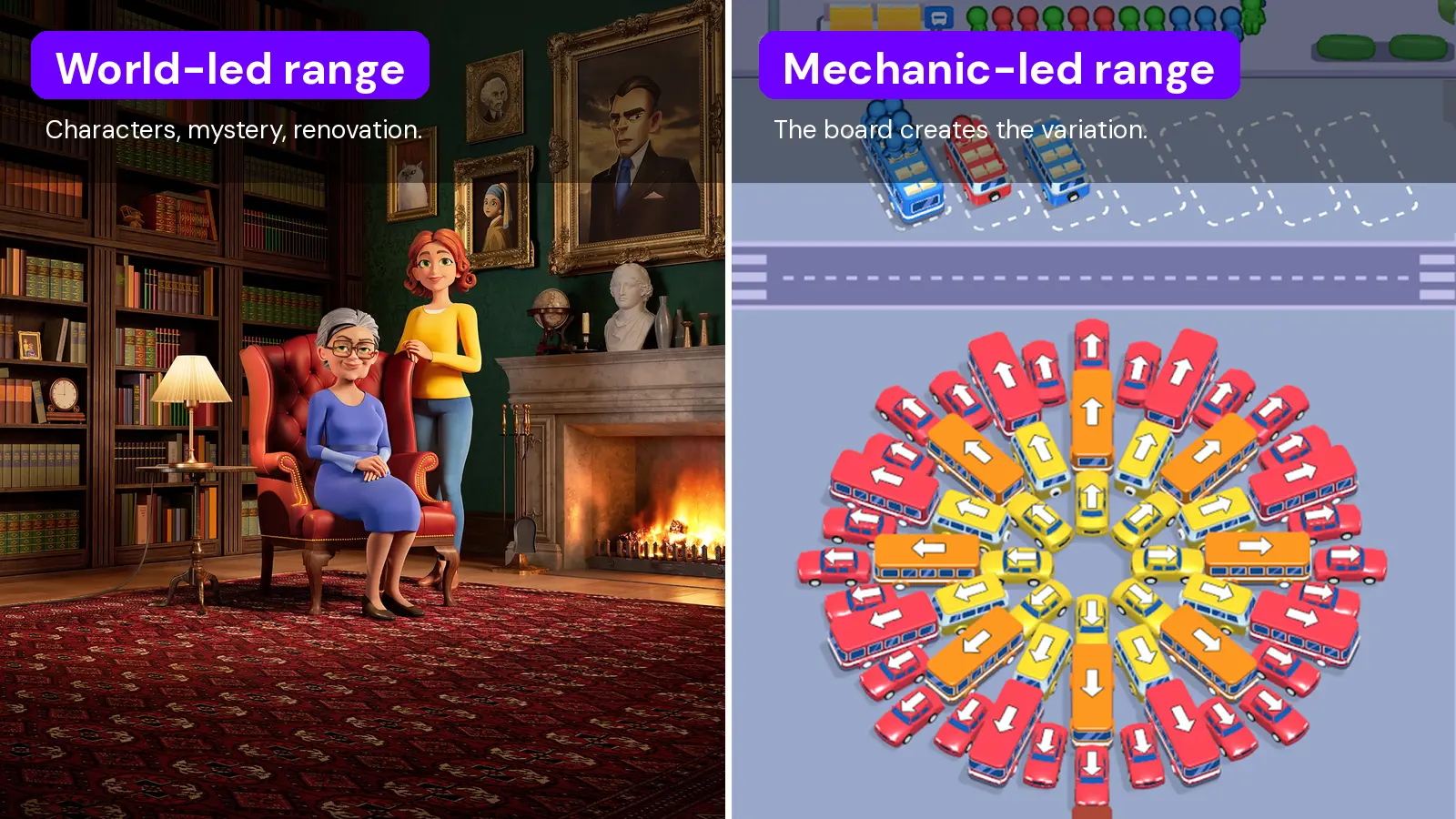
Merge Mansion creative built on character/story vs. a Traffic Bus creative built purely on the board state, same “range” idea, opposite source.
World-led buys years of runway, if the content keeps holding up. Mechanic-led buys a faster verdict: months, not years, to find out whether a mechanic has enough range to carry a UA budget. Neither is the safer bet, they’re just different bets. Know which one you’re actually running before you build a media plan on top of it.
Leveraging the one-second advantage
Block, Arrow, Sort and Traffic don’t owe each other a shared future just because they had a shared year. Four mechanics can post the same curve without turning into one genre, and none of them are guaranteed to keep climbing at this pace.
What they do share is a production advantage most roadmaps file under marketing’s problem to solve later. Keep manufacturing new one-second situations and creative never runs dry on reasons to put media behind you instead of the app next to you on the chart.
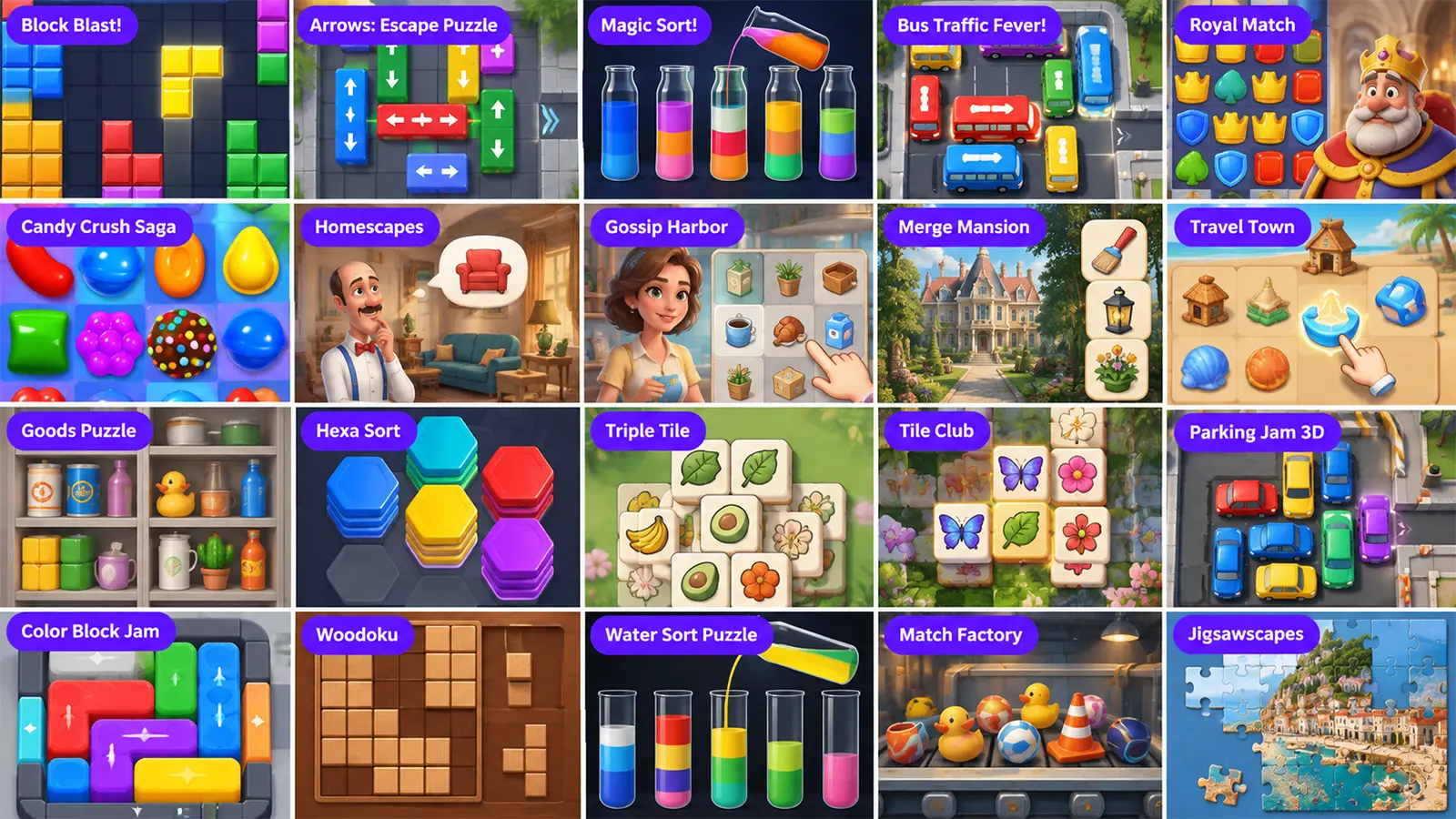
Readability gets you noticed. Pull gets you engaged. Creative surface area is what keeps the ad account fed instead of running on fumes by month four.
A creative team can always dig up one more hook for a game.
A mechanic that keeps generating them on its own is a lot harder to build, and a lot harder to copy.
Source: unified iOS + Android downloads, revenue and DAU across US, AU, CA, CN, FR and 106 other markets, trailing twelve months ending September 6, 2026, versus the prior twelve-month period. Analysis: TapCraft.